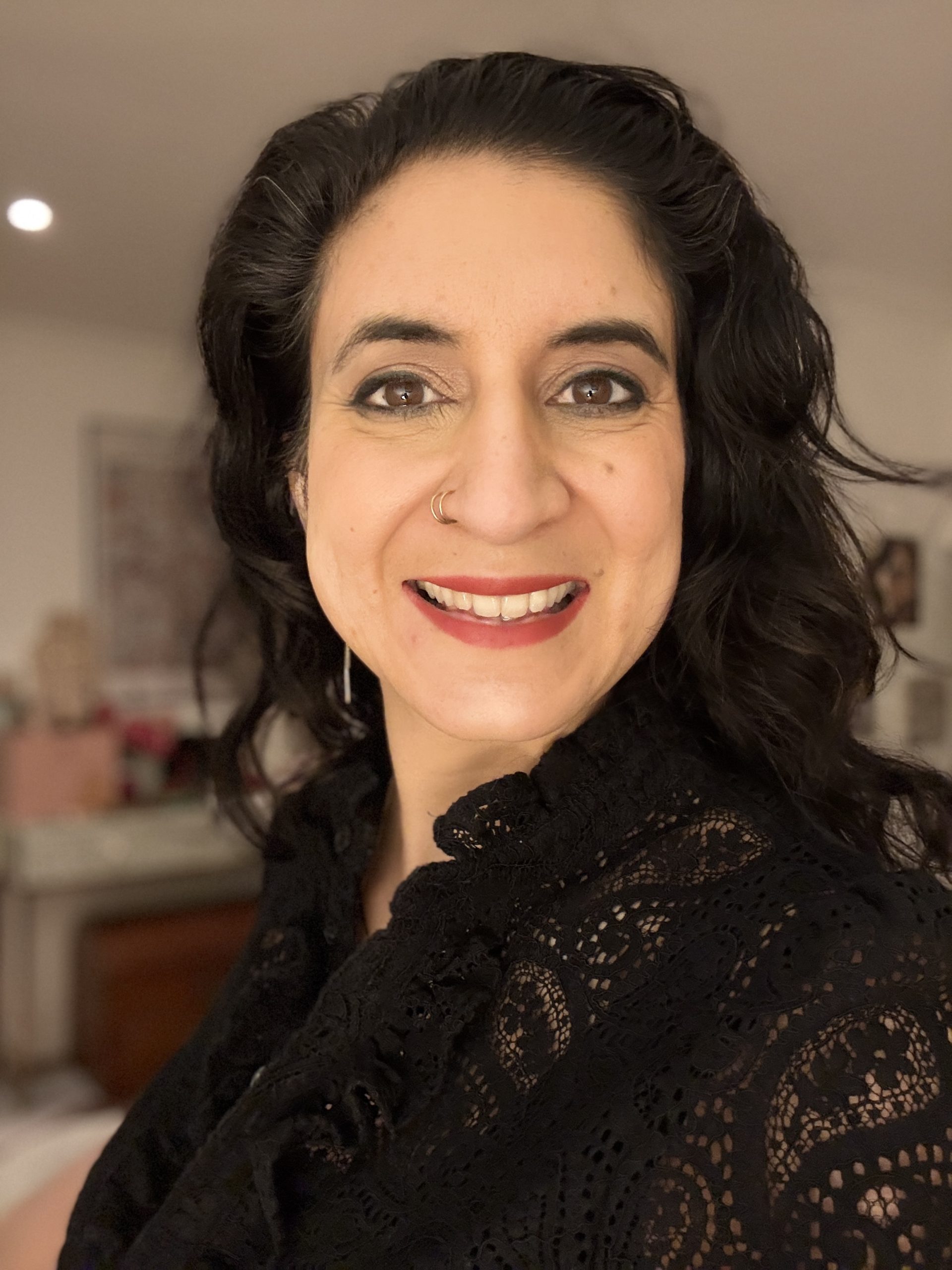
Bea Mariam Killguss is Founder of Third Space Practice. She also teaches and lectures alongside the practice.
Bea holds an MSc in Existential Psychotherapy from Middlesex University and an honours degree in Theology from Brunel. She has published on identity and belonging in the lives of global nomads (APA, 2008) and presented on transracial adoption, cosmopolitanism, and hybridity at the Royal Anthropological Institute.
She was raised between northern Pakistan and Germany by German medical humanitarians, came to England for university, and has since lived in France, Spain, the United States, Australia, and Tanzania. In her thirties she lived and worked in Kabul,Afghanistan teaching professional English to civil society workers, NGO leaders, and government staff across UN, EU, and DFID programmes, and managing communications and education projects through some of the harder years of the last two decades.
English and German are her mother tongues and she is fluent in French and Urdu.
She founded Third Space Practice and is based in South London, where she lives with her partner, two daughters, and a German Spitz with strong views.
The Work
Third Space Practice works with people and organisations in fractured or high-pressure contexts. The practice runs group programmes for people working under sustained pressure, and offers training and consultation for practitioners working in complex human terrain.
A central strand of the work is ongoing psychosocial support for journalists, activists, and civic defenders working under conditions of surveillance, restriction, and risk, in partnership with independent press and human rights organisations.
Bea teaches on postgraduate programmes in London, across modules covering cultural difference and ethics, systems thinking and family dynamics, philosophical and religious worldviews, conflict and reconciliation, the politics of sex and gender, and development across the lifespan. She supervises Masters and Doctoral students working with autoethnographic and qualitative methods.
The Thinking
The frameworks most often used to understand human distress assume a stable self that can be returned to coherence when things go wrong. That’s a partial account at best. It tends to locate the problem in the person rather than the conditions, and to pathologise those who don’t fit.
Bea works from a different starting point. The traditions she draws on — critical theory, existential philosophy, liberation psychology, un-colonial thought, feminist epistemology — take seriously the link between personal suffering and structural condition. Her research treats autoethnography as a method in its own right, where the researcher’s own life is part of the evidence rather than a problem to clean out of it.
In practice, the work is slower to reach for a diagnosis. It questions whether comfort and safety are the same thing. It’s interested in what can actually be built from what’s there.
Do I contradict myself? Very well then I contradict myself, (I am large, I contain multitudes.)
Walt Whitman, Song of Myself Tweet